
Our sustainability strategy
Advancing sustainability through chemistry

Since 2023 we have iteratively engaged with key members of our community across our governance, membership, editorial boards and employees about sustainability, chemistry and the RSC. We brought in insights from recent programmes in skills and diversity, publishing trends and sustainable labs, as well as Future of the Chemical Sciences, Science Horizons and Digital Futures.
We have factored in the changing global environment and sustainability priorities for chemistry-using industries, research and development funders and organisations similar to our own.
These inputs are the basis for our sustainability strategy.
On this page
Our strategy
Our sustainability strategy sets out our understanding of the role of chemistry in sustainability and our plans to drive impact towards the UN Sustainable Development Goals (SDGs).
By sharing our strategy, we want to spark conversations, connect with partners and accelerate collective efforts to maximise the contributions of the global chemistry community to a sustainable future.
Learn more about our sustainability programmes and activities
Read on to see key points from the document.
Sustainable chemistry: growing momentum
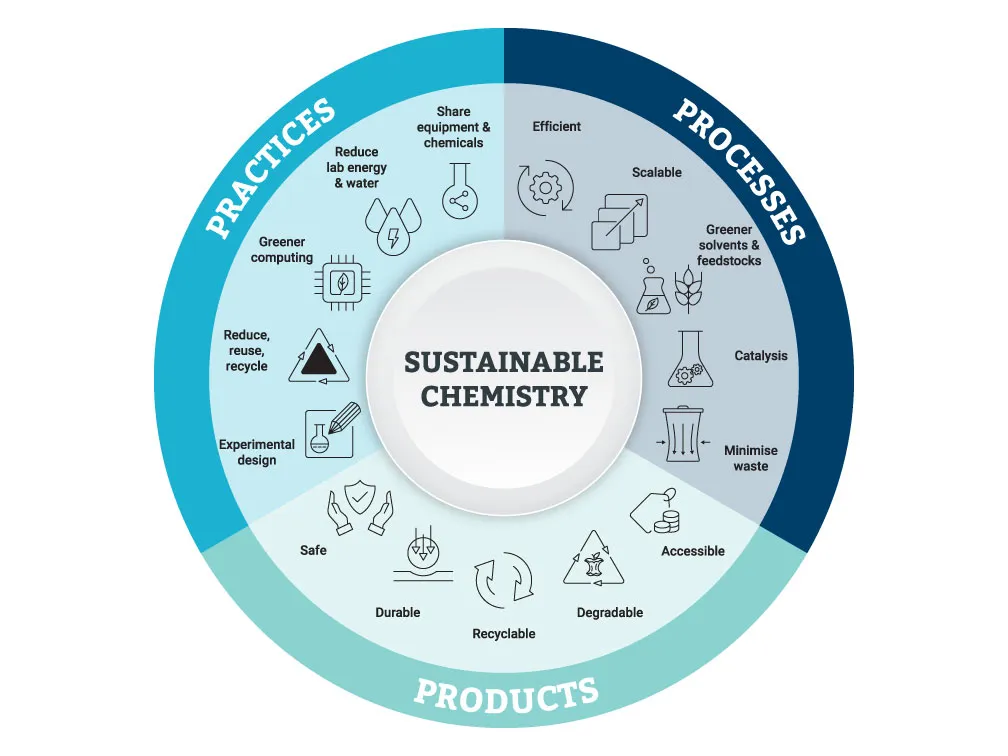
Actions and considerations in the development of sustainable chemistry practices, processes and products
Scientists continually harness new tools and tackle new challenges in a changing world. Today, people, ideas, and communities in chemistry are coming together to create a sustainable future for our people, planet, and economy. Chemistry is key to technologies that improve human life, protect the environment and enable economic prosperity.
Momentum is growing as chemists around the world – and the schools, universities, companies and other organisations where they work – focus on sustainability. Chemists model, measure, and make the molecules and materials integral to everything from food, clean water, and medicines to energy, automobiles, and electronics. From catalysis and synthesis to interfaces with biology, materials science, and engineering, they are harnessing powerful digital tools to accelerate discovery and innovation.
The momentum around sustainable chemistry today involves many evolving subfields and sectors, learning from the past and collaborating beyond academic, industrial and geographical boundaries. Sustainable chemistry involves the sustainability of how chemistry is done as well as what chemistry contributes to the wider world, including:
- Improving the sustainability of today’s technologies and today’s chemistry practices, processes and products
- Embedding sustainability goals in the discovery and development of future technologies, both what the technologies do and the sustainability performance of the technology itself
- Considering sustainability across whole life cycles and value chains, from raw materials to manufacturing and distribution to end-of-life
This view includes both ‘chemistry for sustainability’ and a recognition that chemistry can sometimes have negative environmental, social or economic impacts.
Sustainability concepts and goals are not new for chemists and are embedded across fields from green chemistry, atmospheric and environmental chemistry to measurement science and toxicology, enabling understanding, regulation, innovation and the safety of people and ecosystems.
Chemical scientists and engineers increasingly apply multi- and trans-disciplinary approaches like life cycle assessment, techno-economic analysis and systems thinking to understand sustainability and navigate trade-offs. They are also linking their work to broader social and economic contexts and concepts.
At a more day-to-day level, some chemists are engaging with the ‘green labs’ agenda, while others are engaged with wider Sustainable Science issues like equity and inclusivity, openness, reproducibility, ethics and research culture.
Through our 2023 sustainability strategy development work and ongoing discussions with our community, we have heard that chemists are in different places on their ‘sustainability journey’, from people who have considered sustainability for decades to those who don’t know where to start.
Sustainability is so complex and multi-scale that people begin that journey at different entry points from green labs to green chemistry education to questioning the environmental performance of a material they are developing, or wanting to optimise the environmental, social and economic sustainability of a manufacturing process in their company.
Individuals and organisations variously call what they do ‘sustainable chemistry’, ‘chemistry for sustainability’ or something different again. They might focus on specific priorities within the SDGs, reflecting their local context or their area of science and technology. Across the sustainability spectrum, people use terms in different ways, but it is clear that an ever-increasing proportion of chemists today are working towards environmental, social and economic sustainability goals.
Our impact horizons
We have identified three horizons across which we will drive sustainability impact as an organisation. Each is relevant to us as a global organisation and to our global chemistry community of people across career stages, working in different roles and sectors from schools and universities to companies and governments.
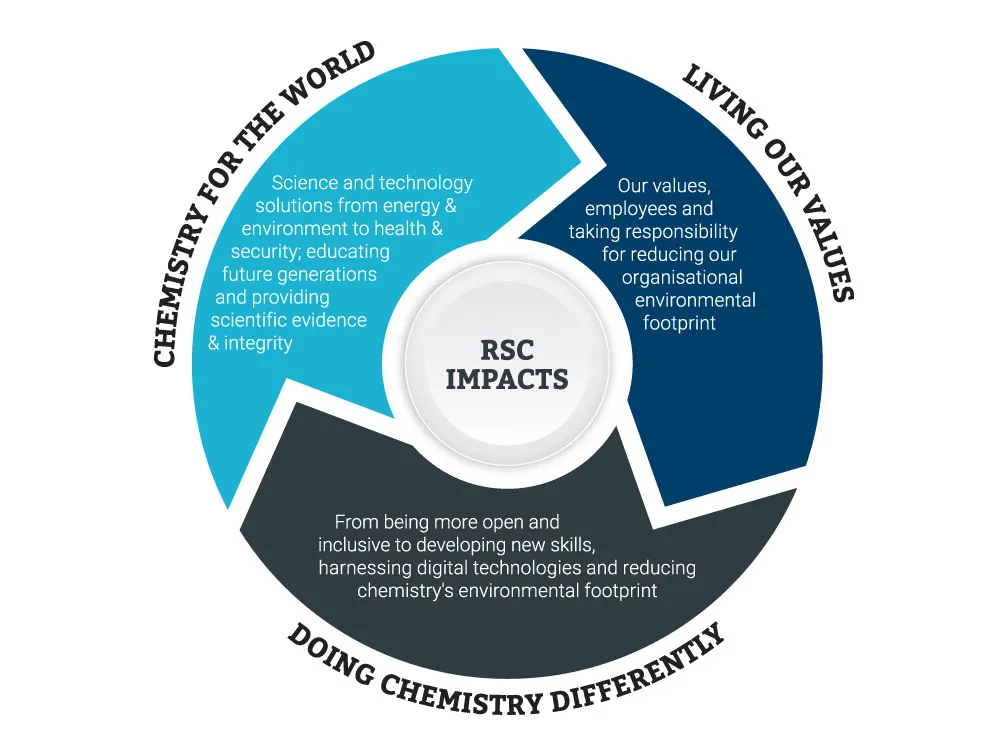
The three impact horizons across which we deliver impact for our organisation, the chemical sciences community and the world
The operational sustainability of the RSC as an organisation and our integrity in ensuring that, as part of the chemistry community ourselves, we strive to have our own house in order.
- reducing our environmental impacts
- ensuring our financial sustainability and ability to deliver charitable impact
- prioritising the well-being of our employees
- committing to inclusion and diversity as an employer
How we guide and enable our community to build sustainability into day-to-day chemistry practice and longer-term scientific thinking.
- helping chemists to change by highlighting and enabling individual agency and supporting collaboration and leadership on sustainability
- convening and catalysing chemists to pursue sustainable chemistry opportunities across the spectrum from discovery to innovation to optimisation of current processes, and from greener labs to harnessing data and digital technologies
- supporting the chemists of today and tomorrow to develop the knowledge and skills needed to contribute to tackling sustainability challenges
- using our inclusion and diversity strategy, and work stemming back many years, to improve inclusion, diversity, culture, equity and accessibility in chemistry
The bridging of chemistry knowledge, experience and insight into wider societal contexts, so that the world can gain the greatest possible benefit.
- helping chemists and chemistry have impact for the SDGs through our programmes and products
- enabling the chemistry community to share and advance scientific knowledge, to optimise current processes and technologies and to translate discovery into innovation that benefits the environment, human life and the economy
- working to ensure that policy and debate are informed by scientific evidence and that chemists bring their scientific toolkit to multidisciplinary and cross-sector sustainability initiatives
Our roles in driving impact
Sustainability has been integral to our work for many years: from publishing and education to science and advocacy. This reflects the multitude of ways in which our community contributes to sustainability, and our partnership with our community in developing programmes, products and services to help the chemical sciences make the world a better place.
As we enter our new 2026-2030 strategy period we will further connect and amplify our sustainability efforts as both a leader and a partner. We also plan to roll out new initiatives to achieve even greater impact for and with our community. This is in parallel with the work captured in our inclusion and diversity strategy.
We play five interconnected roles in driving sustainability impacts through our products, services and campaigns for our community.
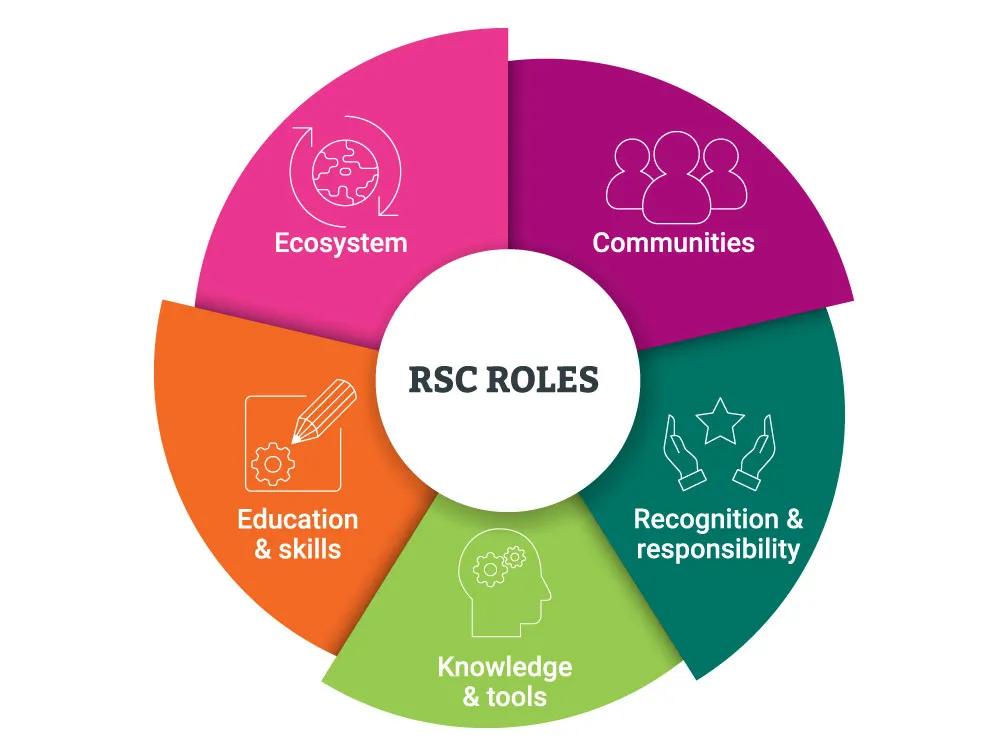
The five roles we play in driving sustainability impacts
Knowledge and tools
Sharing sustainable chemistry knowledge and tools, including consideration of sustainability in the creation, communication and application of that knowledge.
Our continuously evolving portfolio of scholarly journals enables dissemination of research in sustainability-related areas. This content is spread across our portfolio from analysis and catalysis to materials and synthesis as well as in our Energy and Sustainability and Environmental science themes.
- Since 2023, we have launched several gold open access journals linked to sustainability:
- Our book series such as:
- Our desktop seminars providing opportunities for researchers and audiences globally to share scientific advances
- Leading chemists globally serve on our editorial boards, ensuring that the vision and mission for our journals evolves to reflect the scale, opportunity and urgency of sustainable chemistry challenges
- Themed issues bringing together good or emerging practice in sustainability evaluation and life cycle assessment, sharing perspectives from diverse sectors in academia and industry
- Books on topics such as the business case for green and sustainable chemistry
Statements in our journals from authors describing the sustainability advances they are reporting and reflecting on opportunities for future improvements:
- RSC Sustainability Sustainability Spotlight Statement
- Green Chemistry Green Foundation box
- Energy and Environmental Science Broader Context Statement
- Environmental Science: Advances Environmental Significance statements
Communities
Enabling professional networks and environments where chemists learn, discover and innovate sustainably.
- Integrating sustainability across our conferences, including in 2025 our 17th International Conference on Materials Chemistry and the 5th International Solar Fuels conference
- Our Faraday Discussions with a unique format enabling in-depth discussion of themes from batteries and electrofuels to carbon capture and digital chemistry
- Our journal symposia such as our Chemical Sciences Symposium on the chemistry of imaging, biosensing and diagnostics (linked to UN SDG 3)
- Our PCCP Symposium on Physics for Sustainability: Health, Energy, and Environment
- Our member networks and working groups. These include long-standing groups with an explicit focus on sustainability, such as our:
- There are working groups such as our Analytical Methods Committee Expert Working Group on Sustainability
- Our member networks create spaces and connections within and beyond chemistry, forging multi-disciplinary and cross-sector links to share good practice and co-develop solutions. In 2025 our networks convened conferences and events on technical topics including:
- They also convened events on broader topics such as Environmental Toxic Tort focussed on the human health effects of PFAS, and pathways to Sustainable Analytical Science
- Our A Future in Chemistry campaign showcases real-world chemistry careers, featuring video profiles of chemistry professionals working on everything from drug discovery and chemicals manufacturing to textiles and solar energy
- Through our Chem Career and Chemistry World webinars we enable people to hear perspectives and get tips from across the profession. Many are sustainability-themed
Education and skills
Supporting chemists across career stages and sectors to develop sustainability-related skills crucial for economies and societies globally.
- Our criteria requiring green chemistry and an understanding of the UN SDGs for accreditation of degrees
- Resources for teachers to support them in embedding sustainability content and contexts into school curricula
- Our first gold open access book, Chemistry Education for a Sustainable Future
- Reports on topics from the future workforce to the role of digital technologies in accelerating sustainable research and development
- Evidence-based policy recommendations in areas such as sustainability in the secondary curriculum, digital skills and skills for a circular economy
- Themed collections of journal articles such as Measuring Green Chemistry: Methods, Models, and Metrics
- Books and chapters such as:
- Teaching resources and webinars on topics from life cycle assessment to AI in chemistry
Recognition and responsibility
Recognising and supporting chemists’ responsibility and agency in improving sustainability, from day-to-day work to the products & processes they develop.
- Sustainability attribute in the requirement for our Chartered Chemist status
- Sustainability criterion in the selection of our Technical Excellence Prizes
- Prizes recognising and celebrating individuals and teams working at the frontiers of sustainable chemistry discovery, translation and education. See for example our:
- Our commitment to reach net zero carbon emissions by 2040 and annual reporting of our emissions since 2022
- Reductions in waste and in the use of plastic, paper and water in our offices
Ecosystem
Leveraging our leadership and working in partnership to create an ecosystem that incentivises and enables sustainable chemistry
- Convening our international Burlington Consensus series and influencing to ensure the scientific community contributes to the new UN Intergovernmental Science-Policy Panel on Chemicals, Waste & Pollution
- Raising awareness of PFAS and other contaminants of emerging concern, and influencing UK policies, including associated drinking water standards in the UK
- Raising awareness of indoor air quality issues and the importance of circular economy approaches to wind energy generation
- Bringing together academia, industry and policymakers to drive forwards missions to create a sustainable polymers in liquid formulations ecosystem
- Our Change Makers venture programme supports deep tech chemistry start-ups and SMEs aligned with the SDGs
- More ChemLabs mission tackles a UK shortage of chemistry labs for start-ups
- Our longstanding commitment to IUPAC, EuChemS and Commonwealth Chemistry
- The Pan-Africa Chemistry Network, which celebrated its 16th year in 2024, and its biennial Pan Africa Chemistry Congress
- Our collaboration with partner societies globally on the Chemical Sciences and Society Summits themed on sustainability topics from sustainable food and water to plastics and tackling antimicrobial resistance
- Robust processes and ethical frameworks for our publishing content to ensure the quality and integrity of publications
- Our data sharing policy includes mandatory data availability statements for published articles and signposts authors to repositories where we are aware of them
- ChemSpider webinars on topics including data standards and data management in chemistry
- Having identified challenges, barriers and opportunities in making chemistry labs more sustainable we are funding projects to research, develop and share Sustainable Labs solutions
- Our report on Disability-inclusive laboratories and living library of case studies with practical examples of good practice and driving change
Contact our sustainable chemistry team
Get in touch with any enquiries about our sustainability work.
Related pages
Discover our policy and campaigns

Sustainability
Chemistry drives progress towards a more sustainable world.

Research and innovation
The likely future of where chemistry’s greatest contributions will be – as well as the regulatory and funding environments needed to achieve them.

Science culture
Our wide-ranging work to make chemistry more welcoming to everyone.