
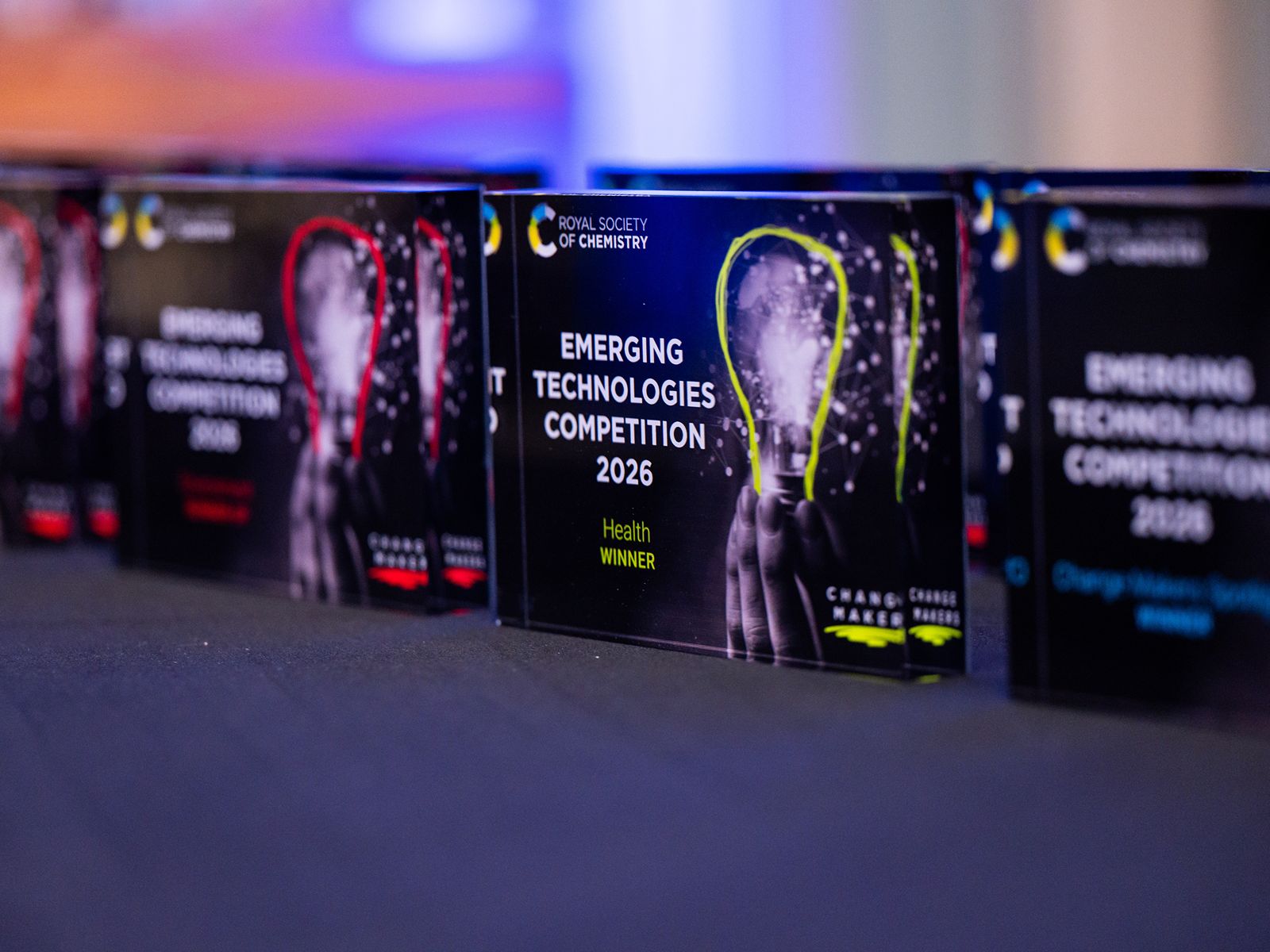
-(1).jpg?language=en&width=1600&resizemode=force&format=webp&v=639203214922398340 "Emerging Technologies Competition 2026 (4) (1)")
Our interdisciplinary judging panel – made up of scientists, industry specialists, entrepreneurs and investors – selected the winning pitches at the final at our historic Burlington House home, on London’s Piccadilly on 21 July.
The winners crowned from each of the competition categories and take home a share in the £50,000 prize pot, plus support, feedback, and opportunities for profile. Take a look at this year’s leading tech innovators who are developing chemistry-led technologies that:
- Enable the creation or improvement of products and services across a wide product scope, potentially in combination with other complementary technologies.
- Are new processes and products that deliver significant energy generation, efficiency, or storage improvements, supporting sustainable energy as part of the transition to net zero.
- Conserve resources, monitor, and reduce the impact on the environment and support the move to a circular economy.
- Ensure healthier lives and wellbeing for all, at all ages, including global healthcare challenges.
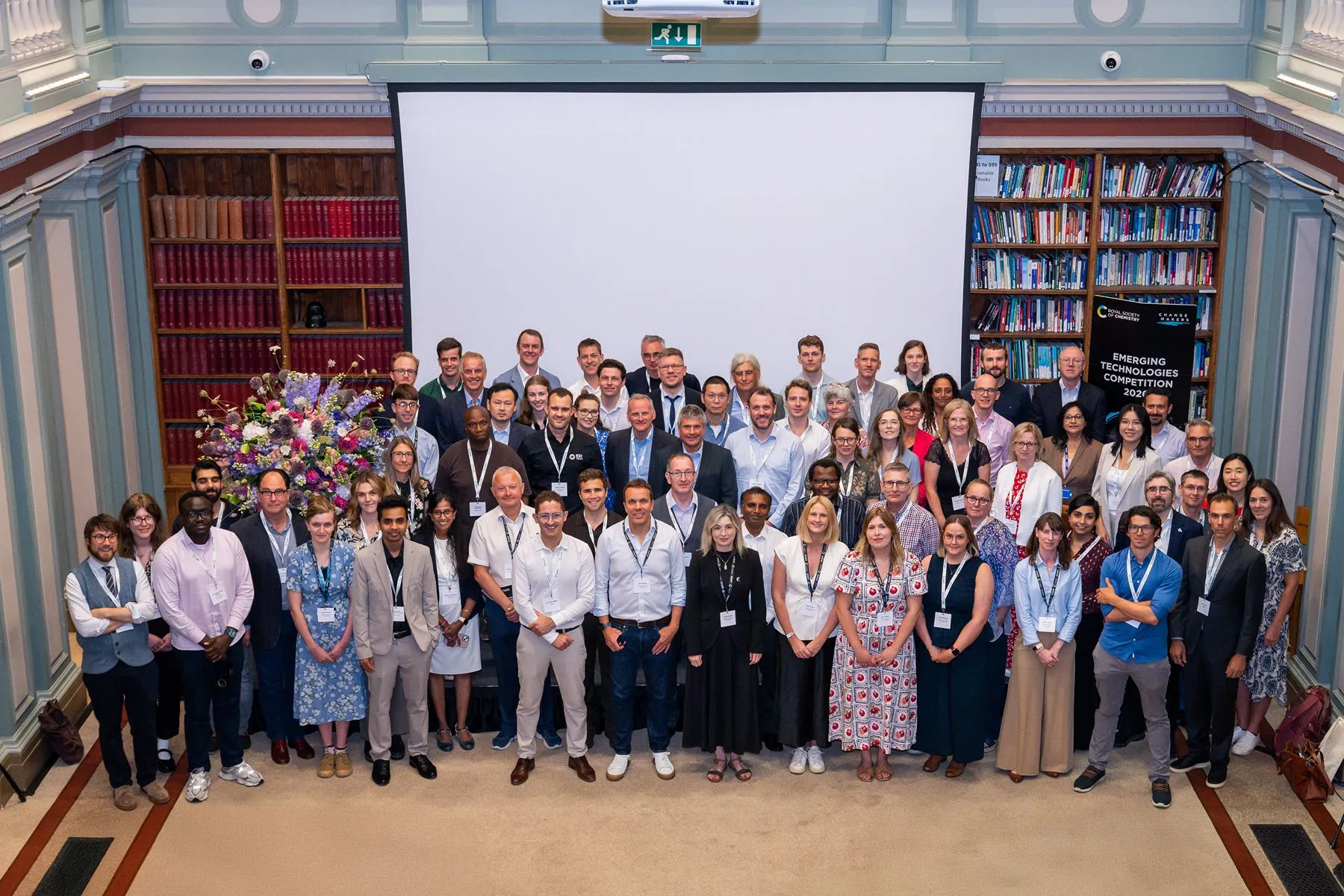
Announcing our winners
- The Enabling Technologies category winner, from the University of Manchester, is Deuterose, whose work looks to enabling research and diagnostics with clean cheap isotopic sugars.
- Read more from Jack Rowbotham and Claire Morley from Deuterose – and watch their winners video – in our profile below.
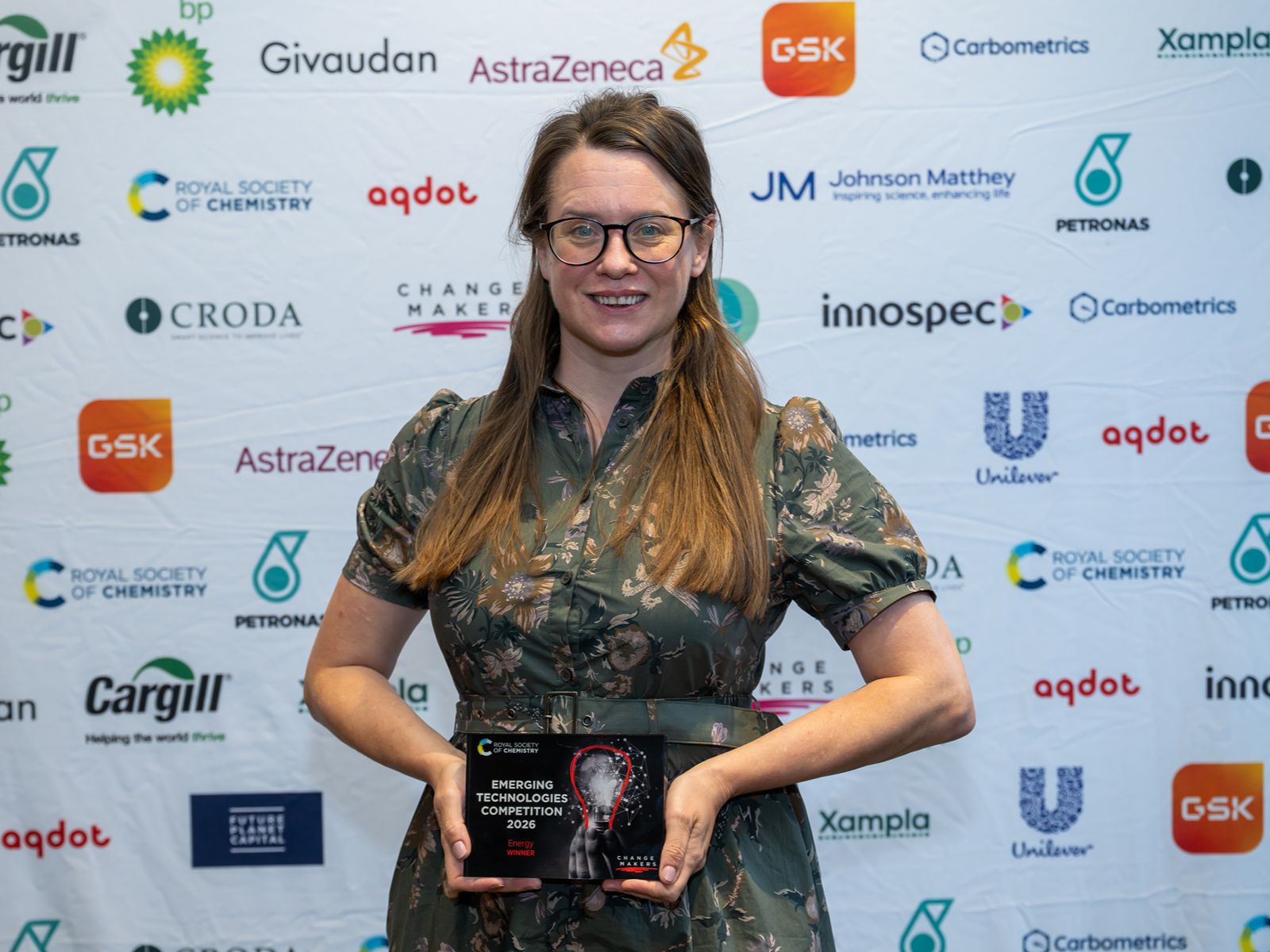
- The Energy category winner is Gavion from Lancaster University. OSPC is a newly discovered porous carbon material that improves the safety and durability of lithium-ion batteries used in electric vehicles and renewable energy storage. When added in small amounts to graphite anodes, it suppresses lithium dendrite formation, reducing fire risk while remaining compatible with existing battery manufacturing processes.
- Read and watch what Gavion founder Professor Abbie Trewin had to say in her profile below.
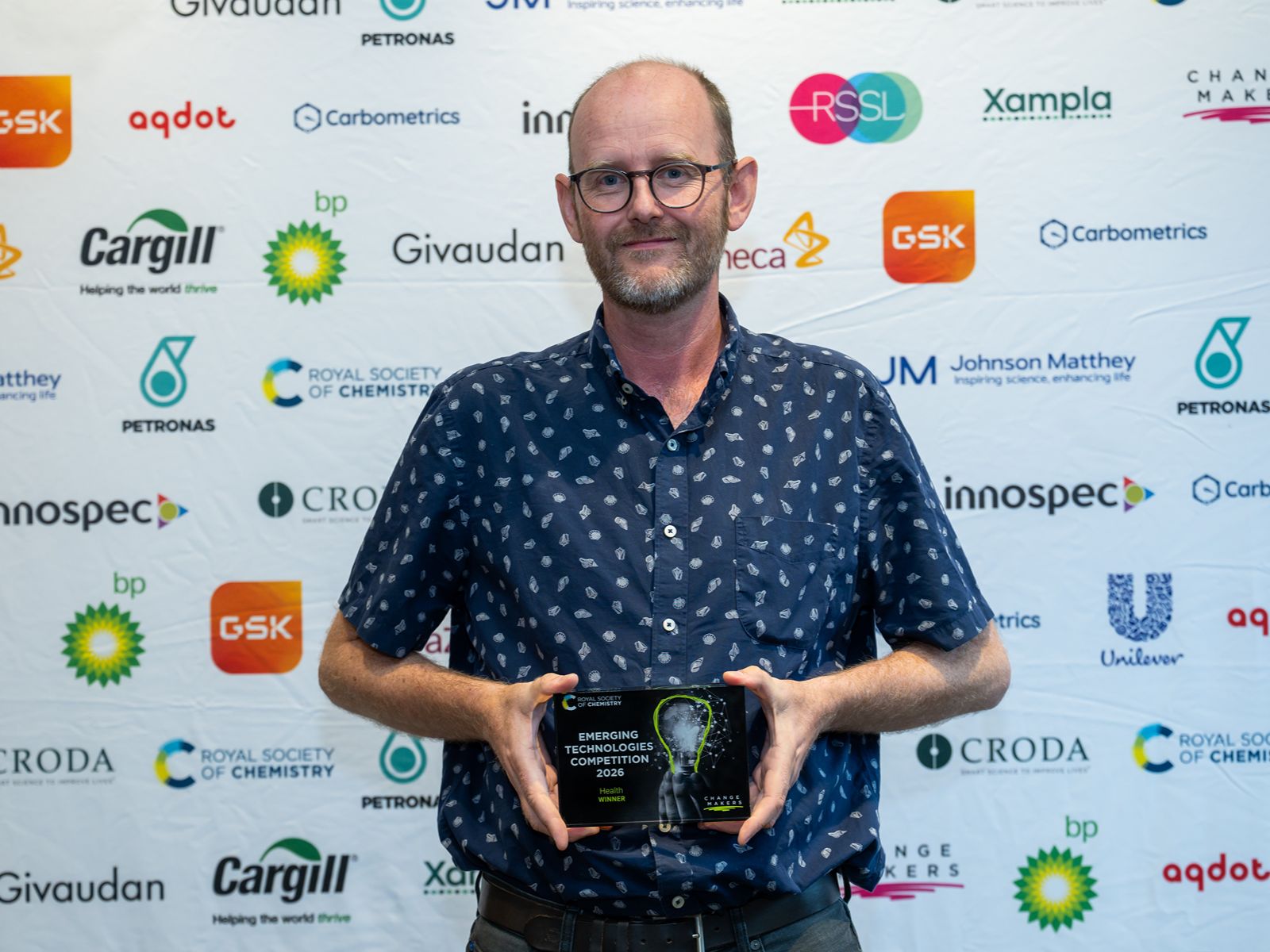
- The Health category was won by the University of Bath’s Revolver Therapeutics. Revolver develops peptide drugs against “undruggable” proteins such as transcription factors. Their platform generates and tests drug candidates directly inside living cells, ensuring they are functional and cell-active. This enables new treatments for cancer and neurodegenerative diseases where conventional drug approaches have failed.
- Jody Mason from Revolver told us about his feeling on being named an Emerging Technologies Competition winner – read and watch below.
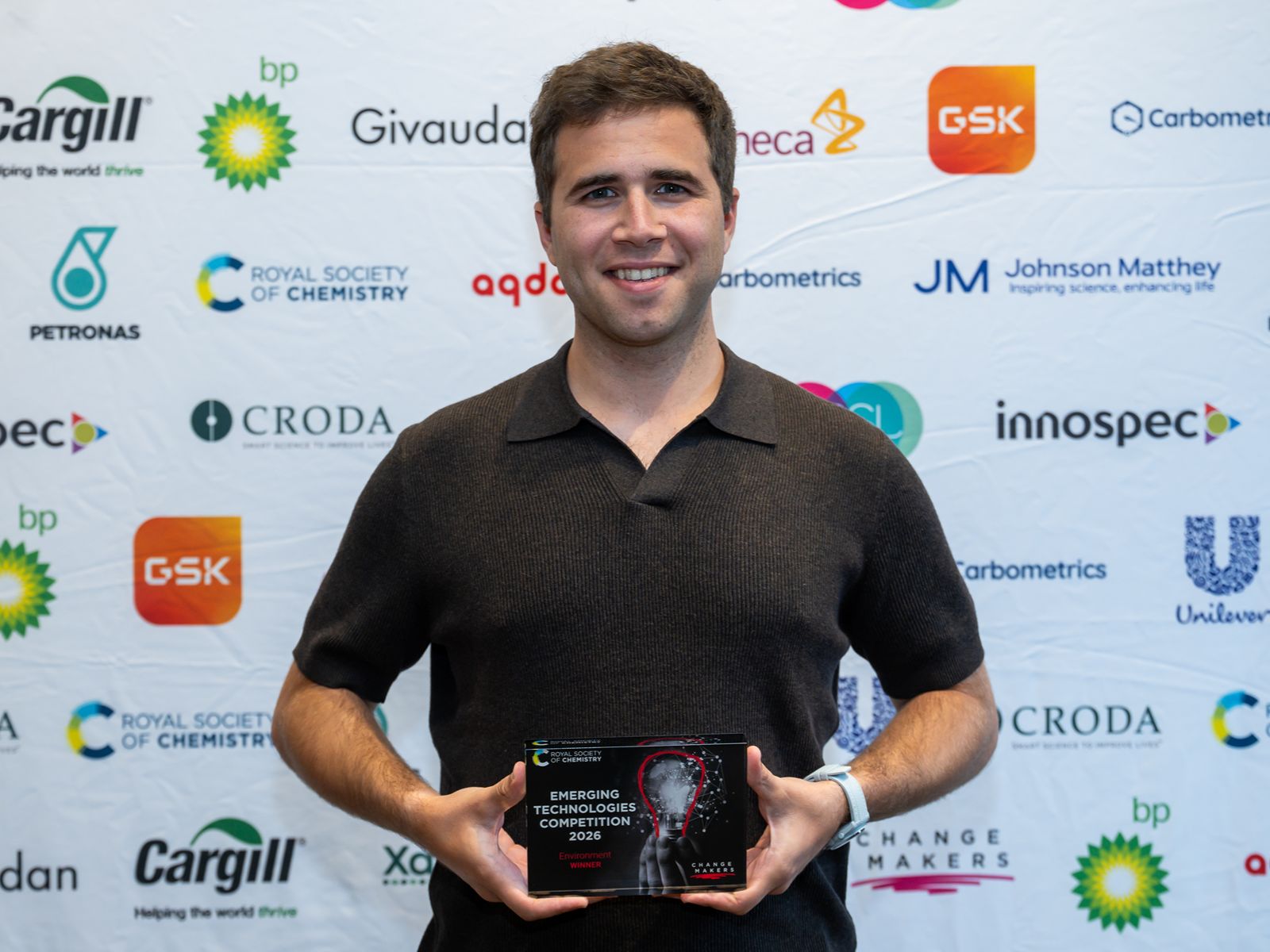
- The Environment category winner is Demeter Bio Limited, whose AguaShield technology is a biodegradable and bio-based coating that replaces toxic 'forever chemicals' (PFAS) used to make textiles water- and oil-resistant. Made from biopolymers, it matches the performance of conventional coatings without harming the environment, and works with existing manufacturing equipment.
- Rayan Osseiran, Demeter Bio’s founder, explained his motivation for getting involved in trying to solve a problem like PFAS. Read and watch Rayan’s profile below.
Celebrating chemistry through competition and sharing expertise
-(1).jpg?language=en&width=1600&resizemode=force&format=webp&v=639203214922604628 "Emerging Technologies Competition 2026 (1) (1)")
Dr Alexander Reip (centre) spoke as part of a panel, giving insights to those following in his entrepreneurial footsteps
Royal Society of Chemistry trustee Dr Alexander Reip – himself an entrepreneur and now Chair of Enterprise Oxford – summed up his day at the Emerging Technologies Competition, speaking on an expert panel and taking part as a judge for the Energy category.
He said: “The experience has been fantastic today. I think one of the really difficult things is – especially when you're starting up a new company – it's a really lonely thing to do because you've got so much on, so many different balls you're juggling.
“It's really, really hard. To be able to bring people together, show them what they need to do, and then to really be able to reward them for the excellent work they are doing – not only the technology but the sorts of businesses that they're building – is really, really important."
This is one of the really great things that the Royal Society of Chemistry do to be able to help support this sort of next generation of entrepreneurs moving forward. It's a pleasure to be part of it.
“Chemistry underpins almost everything, especially in the sort of the IS8 – the industrial strategy sectors – it underpins almost everything. And so to be able to grow new chemical businesses really will help support the future of the United Kingdom.
“First-steps advice is make sure you patent what you've got there early. You want to make sure you do that, especially if you're an academic, before you start doing papers about them and publishing papers. That can be a really big issue if you don't.
“Secondly, make sure you work out in your business who your customers are and go and talk to them very early on to see if the technology you want to develop or that you're developing is of actual need, because the last thing you want is to spend huge amounts of time and huge amounts of resources to then find that actually what you've developed isn't wanted by the market.
“Once you've got that, that will really help lead you on to everything, the fundraising and to be able to grow a business that you know will be successful in future.”
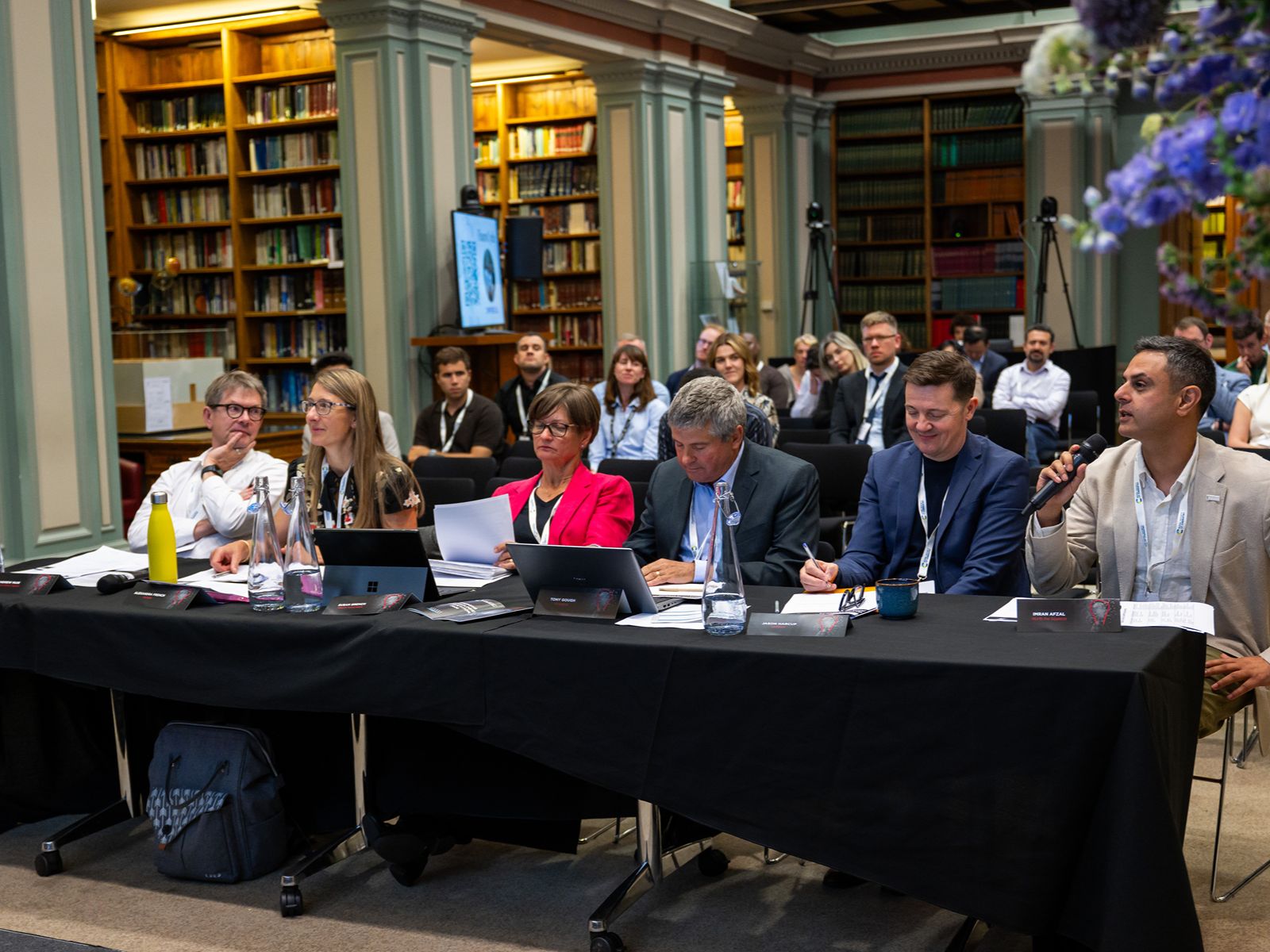-(1).jpg?language=en&width=1600&resizemode=force&format=webp&v=639203214922434724 "Emerging Technologies Competition 2026 (3) (1)")
Our expert judging panels featured a variety of scientists, industry specialists, entrepreneurs and investors
Meet the 2026 ETC winners
Enabling research and diagnostics with clean cheap isotopic sugars
2026 Emerging Technologies Competition prize winner - Enabling Technologies
Deuterose is a new biotechnology for clean manufacture of speciality isotopically labelled sugars. These sugars are essential for a range of research and medical applications, but their high cost makes them prohibitively expensive. Deuterose reduces costs by an order of magnitude, enabling frontier bioscience research and cutting-edge diagnostic techniques.
Meet the team
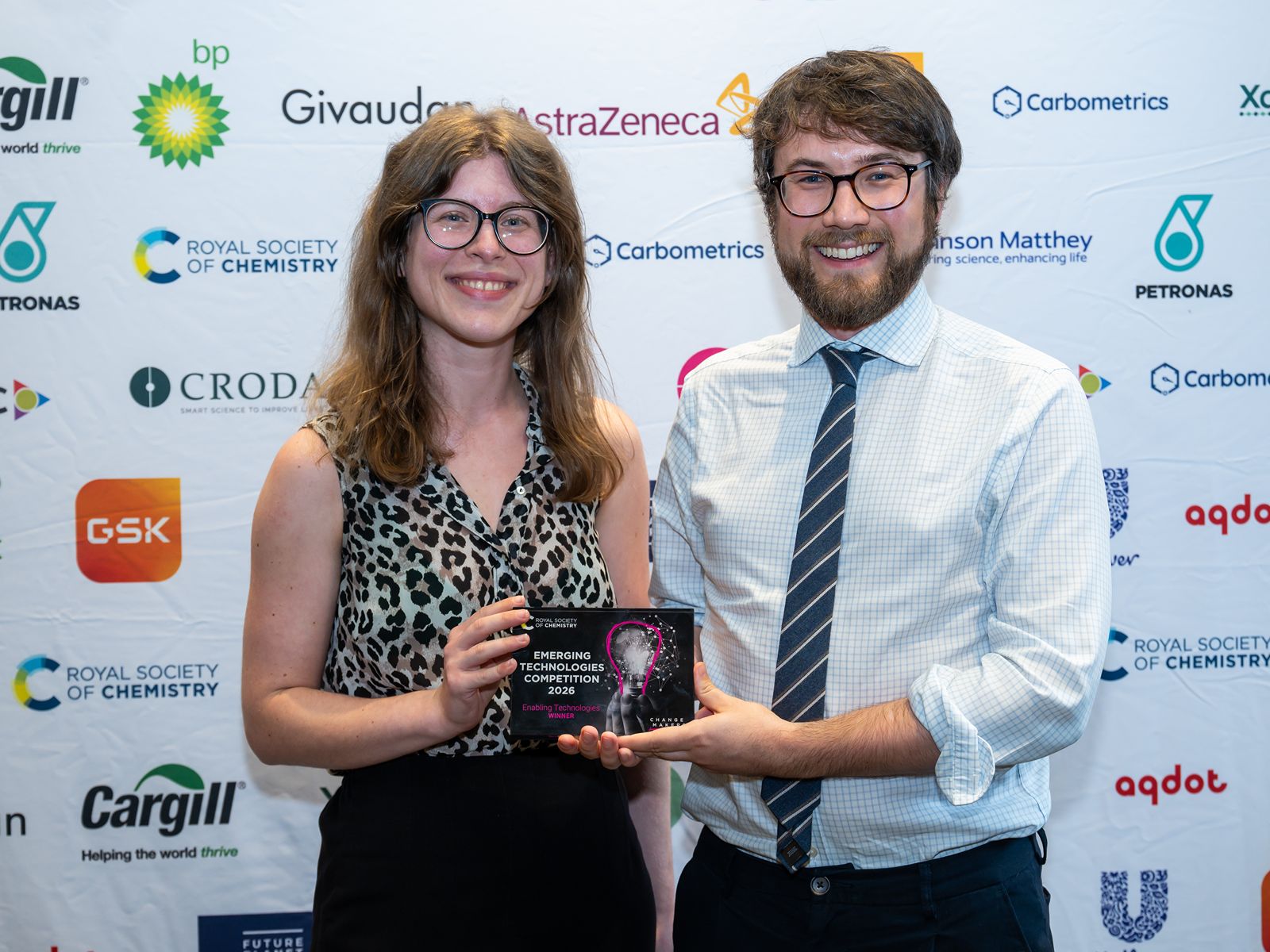.jpg?language=en&width=1600&resizemode=force&format=webp&v=639203216314809313 "Emerging Technologies Competition - Claire and Jack (1)")
Claire Morley, lead biologist, and Jack Rowbotham, inventor and founder of Deuterose
Jack: We're absolutely delighted. We've been named winners in the Enabling Technologies category, which is a real validation for us. We've been working on the technology for some time and thinking about how we can bring it beyond the lab.
Presenting it today to the panel and having it interrogated is a real vote of confidence from the chemistry community that we have something that is worth persevering with.
Claire: Most days I have been in the lab working on my experiments, trying to progress the product. When we've gone out and spoken to people who will be using it, it's shown us how important the product is and it's fuelled us to keep working on it, keep improving to make it better.
Jack: I think we've always thought that this is a nice idea academically. There's some elegant chemistry behind it, but Claire and the team are working with people that can actually use the product. That shows us the potential for real-world impact, which is really driving us forward to spin it out.
On days like today, you see like-minded scientists and chemists - all of whom have got the seed of a good idea - and you see technologies at different stages and you can imagine yourself in their position. It helps make you feel like you're not on the journey alone.
I think part of it is talking to people beyond your field, and I think Claire and I have gone and tried to find end users for our technology. When you start getting feedback, that's the point where you start to feel there's a bit of momentum, and then look for opportunities to go to events like this, to start presenting what you can within the confines of IP.
Just go for it is the best advice that I can give, because you just don't know what's out there until you start presenting it.
We're delighted - we're over the moon to be honest with you! There's a lot of hard work, a lot of teamwork that went behind this, a lot of late nights and a lot of long weekends, especially recently, to get some of the proof of concept over the line. Again, this is real validation for us, the technology, and the team.
OSPC: the new carbon material for safer, longer-lasting lithium-ion batteries
2026 Emerging Technologies Competition prize winner - Energy
OSPC is a newly discovered porous carbon material that improves the safety and durability of lithium-ion batteries used in electric vehicles and renewable energy storage. When added in small amounts to graphite anodes, it suppresses lithium dendrite formation, reducing fire risk while remaining compatible with existing battery manufacturing processes.
Meet the team
.jpg?language=en&width=1600&resizemode=force&format=webp&v=639203216314781892 "Emerging Technologies Competition - Abbie (1)")
Gavion founder Professor Abbie Trewin
Abbie: I’m very surprised - we didn't expect to win at all, but it's a very nice surprise! I'm delighted. I think it's the result of a lot of hard work and we've worked really, really hard to get the results that we've had and to get where we've found ourselves here.
We've done pitches before, but nothing quite like this. It's quite hard to get up in front of 1) a panel of people and 2) an audience. Getting up in front of an audience and being asked those questions is quite challenging. They asked us some very interesting questions that were very pertinent, but it was very good. It was very fair, they asked us really interesting questions that we could answer as well, so that was good – it's very exciting.
For us, it's not the prize money; it's about the kudos and the credibility that we get from winning such a prestigious prize. It opens a lot of doors for us and gets us in the room with investors and people take it very seriously.
It's a big stamp of approval for us that we are an exciting company with real rigorous science that's exciting, and it just means the world to us that we can now show this off!
Drugs for undruggable proteins using intracellular peptide discovery
2026 Emerging Technologies Competition prize winner - Health
Revolver Therapeutics develops peptide drugs against “undruggable” proteins such as transcription factors. Our platform generates and tests drug candidates directly inside living cells, ensuring they are functional and cell-active. This enables new treatments for cancer and neurodegenerative diseases where conventional drug approaches have failed.
Meet the team
.jpg?language=en&width=1600&resizemode=force&format=webp&v=639203216315141534 "Emerging Technologies Competition - Jody (1)")
Jody Mason, chief science officer and founder of Revolver Therapeutics
Jody: I've never won anything before, so I'm feeling incredibly elated to have won this prize, it means a lot to me. We've put a lot of hard work into the idea and trying to raise funding through it. Winning a prize like this really helps to validate that we are doing the right things and we are taking positive steps forward and that others are very interested in the technology that we've got to offer, so I'm very excited to have won the prize, but also to see where this can now lead us.
We've got into this space because we're very interested in developing peptide-based drugs to interrupt or antagonise some of the most important but difficult to treat proteins that drive cancer.
Being able to develop some of these molecules and this kind of modality is super exciting and I'm really looking forward to where we can take these molecules and how we can develop these further and progress them towards the clinic.
I think I'm most excited about the sort of additional awareness that this will offer to the company, and I'm hoping that other investors will now follow and will want to invest in the company. We'll see the sort of USP that we have to offer in the modality that we've got and some of the proteins and targets that we're pursuing as well, so it's going to really help to raise Revolver's profile.
Bio-based water and oil repellent coating for textiles
2026 Emerging Technologies Competition prize winner - environment
Demeter Bio's AguaShield is a biodegradable and bio-based coating that replaces toxic "forever chemicals" (PFAS) used to make textiles water- and oil-resistant. Made from biopolymers, it matches the performance of conventional coatings without harming the environment, and works with existing manufacturing equipment.
Meet the team
.jpg?language=en&width=1600&resizemode=force&format=webp&v=639203216315051187 "Emerging Technologies Competition - Rayan (1)")
Rayan Osseiran, Demeter Bio co-founder and CEO
Rayan: We're developing a PFAS alternative - especially within the textile and coating space, looking at water-, oil- and alcohol-repellent coatings.
We're super excited to win this competition as it's definitely great validation coming from the Royal Society of Chemistry. For us, it's great to see the importance that RSC is placing on PFAS and on PFAS alternatives.
The motivation really comes from looking at the space and understanding how big of an issue PFAS is. For people who don't know, it's causing more than £50 billion in damages every year across Europe alone. That's not even across the globe.
Once I became aware of that figure, it was a very stark signal of how big and important this issue is. As a company and as a startup, when we really looked at this space, we saw a lot of PFAS removal and PFAS remediation startups coming in, but very few PFAS alternatives.
Fixing the past by removing PFAS is one thing, but how do we pave the way forward for companies to also use alternatives so that we avoid the mistakes that we've done before. That was really the motivation for us and winning this award is just further recognition of the importance of developing alternatives as well, and both working in parallel for a cleaner, PFAS-free future.
I think the best thing about this event was meeting people who were on different parts of the journey. I saw founders working in similar spaces that are five years ahead and maybe founders that are maybe a year behind. Learning from those experiences and hearing from the judges and the mentors what different paths they took towards commercialisation, I found incredibly useful because the next step for us is working with industry partners to bring our product to market.
Having those conversations as part of this event are quite useful and they're conversations I plan on carrying further just for us to benefit from the experiences of those that have walked down this path before. It could be maybe not in PFAS, but in different chemistries, learning from them and paving what we think is the best path forward.